Friday, February 24, 2012

Pipeline, Pollution, and Politics: All Suck


    One of the biggest issues these days that regard politics and energy is the Keystone XL Pipeline. The Keystone Pipeline is a pipeline that carries synthetic crude oil and bitumen from Alberta, Canada to multiple parts of the U.S., running all the way to the gulf coast of Texas. This is a major issue due to the many environmental risk that pipeline extension would cause. Some of the risk is the pipeline could pollute the air and contaminate our water supply. It also poses hazard to migratory birds and other wildlife. Also the construction of the pipeline could potentially cause earthquakes because it crosses through an active seismic zone.

    One of the political highlights was not a debate over oil versus alternative energy, but whether we wanted oil from Canada, or Venezuela. The CEO of TransCanada, which is one of the companies involved in the pipeline, said that if the Canadian oil doesn’t reach the Gulf in an Environmentally friendly way, the it would be brought by tankers that produce higher greenhouse- gas emissions and put the environment at greater risk. I felt that this statement is very misleading; what he is saying is technically true, but the all the other environmentally issues that come with building the pipeline is nothing compared to greenhouse gasses. The plans for this pipeline would go throw very valuables places to our environment like the Sandhills in Nebraska, which s the largest wetland ecosystem and it would also cross the Ogallala Aquifer, one of the largest freshwater reserve in the world. By destroying and possible polluting these areas, it would do more harm to the environment than tankers releasing greenhouse gasses. Aside from the physical harm to the environments, people who live on the lands that pipeline would cross, would also be in affected. They would be living in fence-line areas and that would cause major health issues to some people. Some people have already been threatened by TransCanada to confiscate private land, before the government even came to a decision.

     The Keystone Pipeline is a perfect example of how energy-politics in the U.S. affects the masses. It is such a right-wing approach and shows how politics affect the way the our environment is handled. 

Green Eco-friendly Cement


Recently, engineers have found a way to cut CO2 and the energy footprint of cement by 97 percent. This is great news for industrialized countries, as it will pave the way for cleaner, greener urban centers. 
In recent times, cement consumption has been rising rapidly, and according to researcher Dr Alex Moseson, cement is "already responsible for five percent of human-made carbon dioxide." Eliminating just five percent of our carbon dioxide emissions would already be a tremendous accomplishment for our urban societies, whom rely on cement greatly. For this reason, it is remarkable that this alternative form of cement can be created and potentially be standardized. This alternative can reduce our impact on the environment while meeting societies demand for cement, essentially resulting in a win-win scenario for everyone. 


It all began when a Drexel University team created an "alkali-activated cement based on an industrial byproduct, slag, and simple limestone, which doesn't require heating to produce." Interestingly, Moseson states that this alternative cement is "more like ancient Roman cement," and that it was "directly inspired by the pyramids in Egypt."
This alternative cement is currently close to passing an important commercialism milestone. Once this happens, the team hopes to begin marketing for their company, to be called Greenstone Technologies. Remember that name, it may be widely renowned one day.

Thursday, February 23, 2012

Diverging to Converge; Energy Efficiency

Environmental Politics is a blanket term that binds, labels, and classifies countless ideas and theories around this intangible thing known as our environment. Pena often defines the environment as the place where we "eat, play, learn and work". So to define environmental politics we first realize that environment is everything and anything, but if we zoom in on coupling terms like energy with politics we see less of this inexhaustible wadi that can be filled with conceptual ideas, but rather a more specific direction pointing toward branding, image production, policies, infrastructure, economy, social movements, development, etc.
This last week I sat down to dinner with a Senior Policy Analyst for ACEEE (American Council for an Energy-Efficient Economy) to discuss her work at Dinner with a Dawg. While discussing her current endeavors, or what she calls "term papers" I realized that I had no idea about the other. The other are people who work in energy efficiency because it is logical for an independent state, not necessarily for the "green peace" love of nature.
This person focuses on researching that promotes greater energy efficiency primarily in the U.S. by working directly with policy makers and regulators to ensure that energy efficiency and distributed energy systems are sustainable for future energy demands. She basically views energy as something that needs to be harnessed in a way that is more efficient so that we can continue to match our needs with the demand; this is most commonly an economists paradigm of enviornment and really energy politics.
 
When we think of economist opinions toward energy politics we think this;
"alternative energy sources= New locations to drill for gas and oil"

...but after doing some research on the ACEEE a person would only conclude that energy politics involve and policy making occurs with a dynamic group of individuals that represent a broad spectrum of ideas, passions, and interests. The goal might be long term independence and sustainability for the U.S. which can be disguised as natural resource preservation, wildlife conservation, economic sustainability via efficient energy.  These paths are in constant disputes in the media as anti one or the other, when in all actuality it takes a collaborations of these paths to form a road that leads to the success of these goals.

Sometimes the answers are far too obvious to be considered academic or innovative, but unfortunately we often classify people using essentialist theory, and therefore use essentialist solutions. We rally around fixtures and ideas that promote our goal using our path without considering that others might be working toward the same goal. This limits the impact of intention as it creates a stratified states, and tons of red tape (keeping policy makers from actually instituting plans into action). What I learned from ACEEE is that we just need to use dynamic thinking to develop a cohesive network of collaborative solutions.
  -JC
 

Salmon Conservation

In my other class, we are discussing salmon conservation in the Pacific Northwest.  This is a very pressing issue that resonates with many different interest groups.  Environmentalists want to conserve and preserve the salmon for ecological reasons, Native Americans want to conserve the salmon for cultural reasons, fisherman want the salmon for economic benefit, while industries are more interested in the electricity the river provides over the salmon.  Salmon runs have been decreasing for decades now and there is threat of extinction.  Some technological fixes that have been done include fish hatcheries, fish runs built alongside dams, and barge transportation to the sea.  This type of conservation falls into something we discussed in our guest lecture today: oversimplification and technological "fixes".  A quote from a reading by Richard White states, "In the virtual Columbia electronic fish swim past electronic dams on video terminals...but this oversimplifies."  This type of conservation with heavy human involvement can make the salmon and river relationship too simple and reductionist.  The complex system that revolves around salmon runs in the Northwest is very specific and crucial.  The reductionist method of applying quick technological fixes cannot encompass these complexities, nor have they shown any progress.  Salmon runs are still declining despite these conservation methods.  In the climate justice lecture today, we discussed how the simple idea of a technological fix must be abandoned.  This holds true to an extent with conservation as well.  The ecosystems present in nature are far too complex to apply a quick fix, for it oversimplifies the system as a whole.    

Wednesday, February 22, 2012

Humor Shedding Light on Conservation

An article in the Onion was written about a massive food chain mix-up when an Osprey had allegedly attacked and eaten a lion.  Of course, the Onion is not a reliable news source and is quite humorous, but I believe this article discusses some underlying issues about conservation and the interconnectedness of nature.  The food chain is an important part of conservation because it reveals how everything biotic is related and dependent on all other biotic organisms.  The slightest change in the cycle of energy could potentially alter and disrupt other parts of the web.  This is seen through examples like DDT contaminating fish which are then eaten by birds who die.  The Onion's exaggerated example of a bird devouring a lion could also hold potential of disrupting the entire chain.  At the end of the article, there is a concern about where humans fit into the food chain now that any animal is eating whatever it wants.  An EJ critique of conservation biology is that it does not account for the role humans play in nature; humans are only a destructive force.  The Onion article makes light of this point by showing how humans are actually involved in changes in the environment, and they are not the only cause of change.

http://www.theonion.com/articles/osprey-devours-lion-in-massive-foodchain-shakeup,26773/ 

Zoos

I went to the Point Defiance Zoo and Aquarium over the weekend.  It was exciting to see many exotic animals, despite my negative predisposition to zoos.  As I walked around the exhibits, I could not help but think about urban ecology and conservation.  Elephants always look sad in their small cages.  The large cats have a good amount of play area, and the fish in the aquarium are not fully aware they are on display.  However, when I came to the Arctic Exhibit, I thought about these animals interacting with this environment.  Urban ecology is, after all, the ways in which nature interacts with its urban environment.  These animals have been moved into a new environment: an urban landscape.  The Arctic foxes are blindingly white and beyond fluffy with a thick coat of fur, but how are they adapting to this urban Northwest landscape?  There is barely enough snowfall to stick for an hour out of the year, the landscape is mostly green and blue, and the weather stays at a fairly consistent temperature year-round.  These foxes were built to blend into their snowy surroundings, keeping warm with their thick blanket of fur.  I asked myself, are these poor animals over-heating?

Moving along to the Caribou and Muskoxen, I happen upon the same questions.  These animals are built for a very cold and remote climate.  How can they be living in such a drastically different environment?  This brings in conservation.  Part of the goal of zoos is to conserve endangered species in order to keep the populations alive.  Is this ruining the true nature and spirit of the wild?  Are zoos the best form of conservation?  In class, we have discussed the Core Design.  This design involves sectioning off zones to be undisturbed, surrounded by buffer zones.  As one travels to the center of these areas, human interaction decreases.  These designs are also said to be more effective as smaller areas placed in many different locations as opposed to one giant reserve.

With the question of zoos, I wonder if core reserves should be placed in areas only pertaining to those wild and native species.  Zoos would no longer be able to boast that they have an animal from every part of the world, but the conservation of the animals would improve due to them living in their natural environments or at least closer to them.  The ecology of zoos is quite interesting in an urban setting.  It sparks thought about studies that could test reproduction rates, moral, and mortality in different zoo environments. 

Friday, February 17, 2012

Broadening Urban Ecology


Urban ecology brings about many concerning ideas in the modern age. We face a time where the world is becoming more and more connected and where cities are becoming more crowded. The role of nature in the concrete environment comes in a variety of forms. Areas exist that are created by humans as a means of creating ecology within the urban environment as well as areas that are preserved by humans. Sadly, I believe the more common scenario is that of the former. As cities expand and grow, the presence of nature will only become more artificial and thus less natural with the forced creation of parks and artificial biome bubbles.

When one walks through the busy streets of a city's downtown they are bombarded by the noises of cars and buses driving by, while weaving through a mass of people in a rush. It can be a harsh environment that is constantly growing in size and volume. Accordingly, nature's presence has been destroyed within the cities and now, in the face of growing conservation efforts, there are efforts to compensate for the harshness of the urban world. It has become a common thing to find apartment complexes with central courtyards with flowerbeds or rooftop communal gardens for residents to share and develop. Yet, the question remains as to whether or not these are the correct methods for attacking the lack of nature in the city. By creating a facade of a natural environment and pushing for something that is not natural, does one risk the taking a step backward as opposed to a step forward in enhancing urban ecology?

The city is a city and there are no methods to perfectly integrate nature and cities in the present world to the lengths one would like. Therefore, if we improve the natural terrain surrounding a city then we may find a new urban ecology. Seattle, for instance, while boasting some beautiful natural environments within the city itself also manages to have a beautiful natural landscape full of hiking, kayaking, and other opportunities. The relationship is unique because a person may drive outside of the city and find forests, lakes, and mountains for exploring within minutes of leaving. In that respect, that may be the solution for current ecological problems, a separation not a synthesis. Keep a city as green as possible and let nature have a presence in its artificial ways but make stronger efforts in the ecology of a city itself by making its spatial location in the framework of its region more ecologically friendly.

This is not possible for all cities as many are within a web of many other cities, thus making the solution more complex. However, urban ecology is very complicated in its own right as it is study of the natural and the created and their relationship. To find the correct solution there simply needs to be an implementation of new techniques on all fronts within a city and outside of it for city-dwellers to foster a relationship with the natural world as well as the urban one.

Sunday, February 12, 2012

Urban Ecology 'On-The-Real'

We now live in a place where we 3 out of 5 people will be living in urban cities by 2030, according to the BBC, even faster if we take other factors into consideration. Our rapid growth towards urban living poses a threat to our environment and could have a negative affect on our ability to live in a sustainable manner. If we do not change the way that we are living or assess the rapid growth of urban cities, all of our resources will be gone and we will have to dramatic action that is not good for our country.
Addressing the issues in each major city and know the issues is something that we have to figure out soon, in order to change our urban ecology. I have no doubt that we will be in cities where we share cars and other means transportation to get around; its just part of the cycle. The thing we have to figure out, is how do we make sustainable and green and environmentally- friendly. I think if we can answer those question, we will have better chance at be successful. 
There are techniques out there that can study the needs and wants for certain urban setting; not all urban settings are alike. There is an organization that is call BMW Guggenheim Lab that does this kind of studies. They would go to an urban area and setup a small, modern-looking temporary structure that is both a think-tank and community Centre, designed to identify and solve urban problems.
Living in such urban settings, I think, will be more benefical to people a lot more than we think. The idea of having everything in walking-distance of each other is going the ultimate goal and understanding how to setup such infrastructure sustainably, is what will make successful urban living.
New York 'urban lab' seeks to solve city-style problems

Friday, February 10, 2012

The Concern Over Smog


Los Angeles, CA

In our modern day and age, our cities—our urban ecosystems are being shrouded in smog. Cities with vast populations tend to have it the worst, as air pollution often becomes too noticeable to be ignored, resulting in “smog days.” Beijing is a good example. Walking down the streets of Beijing, it has become impossible not to notice the smog in the air. Similarly, many of California’s large urban centers suffer from smog and various sorts of air pollution. The smog poses an ever-present health risk, resulting in various respiratory problems such as reduced lung function and asthma. Moreover, smog contributes to many more problems, including cancer and heart disease. It’s no wonder the
In the 1970s, Los Angeles, CA, experienced air pollution to an extraordinary degree, where residents of the city were recommended to stay indoors during a smog day. The smog problem has remained over the years, however.
So what can be done about this pollution?
The Clean Air Act, a bill introduced in 1970, allowed the government to set standards on air pollution. It set many guidelines, yet they were poorly enforced. Unfortunately, polluting companies would often “challenge the validity of the Clean Air Act, attempting to find loopholes or undo laws,” basically serving the interests of the lobbyists and profiteers. Today, it is in the people’s best interests to continue improving and enforcing the Clean Air Act. Large urban centers house hundreds of thousands of people who will benefit greatly from better air quality. The reasons behind the companies’ opposition of the Clean Air Act are simple: cities are largely populated by marginalized groups. Seemingly, polluting companies have no concern for the health of these people. 

Thursday, February 9, 2012

Who Ordered the Nuclear Reactors?

Summary — The American Energy Act of 2011
Overview
"The American Energy Act of 2011 enhances the energy security of the United States.  For decades, our nation has been restricted by overly burdensome regulations and legislation that prevent Americans from producing homegrown energy.  This bill puts power back into the hands of the American people.   The American Energy Act will boost the American economy and help create millions of jobs by putting government back into its rightful place and empowering Americans to develop our nation’s vast energy resources." (see the link for the entire act summary)
http://www.instituteforenergyresearch.org/american-energy-act-of-2011/ 

Looking over the language of this "Energy Act" there are a few striking ideas about the "rightful place" of America and "empowering Americans". These words represent a highly politicized theme that energy can be used to harness a kind of worldly strength. This is highly problematic for several reasons; since when were American values turned into imperialistic promises, and what delusional sphere equates nuclear reactors to power?

When the Republican House initiated the Energy Act there must have been a stir because we are in a trend of clean and renewable energy sources (current research being expensive makes it not a republicanly housed priority), but after the actual submission of the Act we see that the intention is not to follow the trend.  This proposal completely diverges from the trend, and is attempting to use the promise of jobs and economic growth to encourage harmful energy production by deregulating.  A new energy plant hasn't been ordered since the 1970's, and now "Mike Pence of Indiana" wants to build nearly 100 reactors within the next 20 years.

Where are they going to put 100 new nuclear reactors? Looks like it is your backyard. There is such a high stratification when it comes to the institutionalization of acts, and this stratification is that the people making decisions or proposing the ideas don't have to live with the consequences.  Is Mike Pence going to live next to a nuclear reactor? I think not. And what if he can promise that they won't be built in neighborhoods then where else; in our fields polluting, or in the environment ravaging the wild?
In this Scenario we can see the harmful use of language in energy politics as politicians use persuasive techniques to blind the public. The fear people have reached in this country because of the economy is unfortunately a great tool for politicians to not only levy the public but also their peers. Aside from the use of guerrilla tactics on this campaign what does the wording of the act say about the American relationship to energy and ultimately the American identity.
-JC

New Ecological Technology In Amazonian Rainforest


Ecology studies the relationship between the environment and its organisms. There are a variety of methods for interpreting ecology but when it comes to determining the ecological state of an environment, technology plays a crucial role and can provide critical data for the ecological analysis of an area. This data could be vital to the conservation and management of said environment, therefore the pressure for new methods and techniques to measure the ecological state of certain environments is constantly evolving. By measuring the ecological state of an environment, we gain knowledge into things like degradation, or through a more anthropogenic lens, gain insight into the human impact upon an environment.

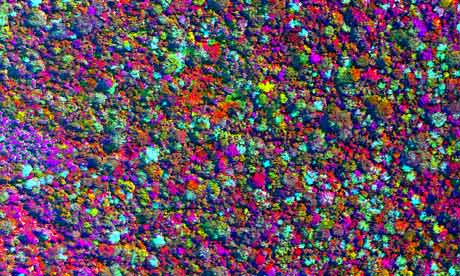
Recently, the Amazon has been an environment tested by new technological that hopes to provide new ecological information for conservation efforts in what it is an environment known for its resources as well as being on the front page of conservation news for many years. Using a machine called a Lidar (Light Detection and Ranging), tropical ecologist Greg Asner and his team mapped out an area of Peru by shooting lasers 400,000 times per second to create a 3D map of the rainforest from above. 

While showing the immense biodiversity of various regions of the Amazon, the Lidar is capable of monitoring the degradation and deforestation of the mapped region. That data could be particularly useful to United Nations' REDD (Reducing Emissions of Deforestation and Forest Degradation), the soon-to-be biggest funding for Amazon conservation.

Here is a link to the article and a video of the 3D mapping: 


Community Conservation in Zanzibar: Not Just Mangroves and Monkeys

An article in Science Daily yet again shows how conservation should reflect the connection between resource users and specific resources.  The study examined community conservation in Zanzibar and how successful its goals were.  The results revealed how "community conservation projects commonly fail because they are too mired in concern about regulating, or perhaps more accurately constraining, the 'direct' relationship between resource use and users."  Accounting for the relationship between humans and the non-human environment falls directly under environmental justice.  While preservation fails to incorporate any connection between the two, conservation places regulations on the connection between humans and the use of resources.  Conservation should, however, recognize this connection in order to create better policies for the environment and the people interacting with that environment.  By understanding the varied interests of resource users, community conservation should be "seen not just as 'local rational resource users', as they largely are now, but as people with differentiated socio-economic and cultural interconnections and interests," as the article states.  This approach also acknowledges the indigenous cultural connections with nature that are largely ignored by most conservations schemes.

http://www.sciencedaily.com/releases/2011/12/111229091640.htm   

Sunday, February 5, 2012

Current Issues with Modeling Urban Ecology

This article discusses the current issues with way they model the growth of urban ecology. Some of the issues that they discussed was the way they assess urbanisation in a simplified way.
I think this is a big issue that needs to be address to ecologist. If we cannot accurately model the growth of  our urban areas, that will cause bigger issues down the road. 
Urban Ecology Model 'Needs To Change'

Super Bowl XLVI

I know this has nothing to do with Environmental Justice, but I think it is worthy of posting...
GIANTS ARE SUPER BOWL CHAMPIONS!! CHHHEEE HEEE!!!

Hope we dont get in trouble for this, group. If we do, I apologize!

Saturday, February 4, 2012

Green Engineering at its Finest

Here is what the beauty of the engineering can do!
If you haven't been to the any these big cities where green technology is common jargon, then you might have no idea what I am talking about. Big green cities like Portland, San Francisco, and Seattle all embrace the idea of going green. By having these green ideas in these urban settings raises awareness about the different types of sustainable technologies that exist. The following article, I hope will depict what I'm trying to convey. I think this article is a good depiction of urban ecology.
How one inventor wants to boost EVs with a towable turbine

Thursday, February 2, 2012


Renewable energy sources have made progress today as Feds have announced that wind farms off the East coast cause no environmental damage, opening the door for developers to begin building and leasing land. This is huge not only for renewable energy sources, but also for creating jobs and industries. Companies like Dominion Virginia Power look forward to building as many as 400 turbines but were held back due to lengthy federal reviews that are now over.

ViaThe Huffington Post

Good news such as this follows somewhat troublesome news for energy politics in Maine who have had a referendum pushed back due to a lack of signatures. The referendum, if passed, would make Maine have 20% of its energy come from renewable sources by 2020, which is a great stimulant to the renewable energy industry that is now postponed until 2013. Nonetheless, it demonstrates the growing effort of people to seek renewable energy sources in the shift away from fossil fuels.

ViaThe Huffington Post

Rehabilitating Vacant Lots Improves Urban Health and Safety

  An article posted in Science Daily about "greening" vacant lots is yet another example of how urban ecology is an environmental justice issue.  As the article quotes, "Improving the places where people live, work and play, holds great promise for changing health and safety."  A study was done on the effect of "greening", or transforming vacant/waste plots into environmentally-friendly and clean spaces, in neighborhoods.  The study was "one of the first rigorous studies to show that reducing physical decay in neighborhoods...reduces public safety crimes, demonstrating that healthier places are safer places."  This also shows how location and place is extremely important to public health.  While these sites are not specific to indigenous populations or the place of relocation, they still impact a neighborhood's overall health and safety.  This agrees with our conversations about personal and cultural health being related to place.  If a place is polluted by dumping and exposed toxic waste, the health of the community declines as well as the overall safety.  "The large number of vacant lots we studied and the design of our analysis make this study some of the strongest evidence to date that greening vacant urban land is a promising approach to improving health and safety," says the scientists involved in the study.

http://www.sciencedaily.com/releases/2011/11/111117140420.htm